
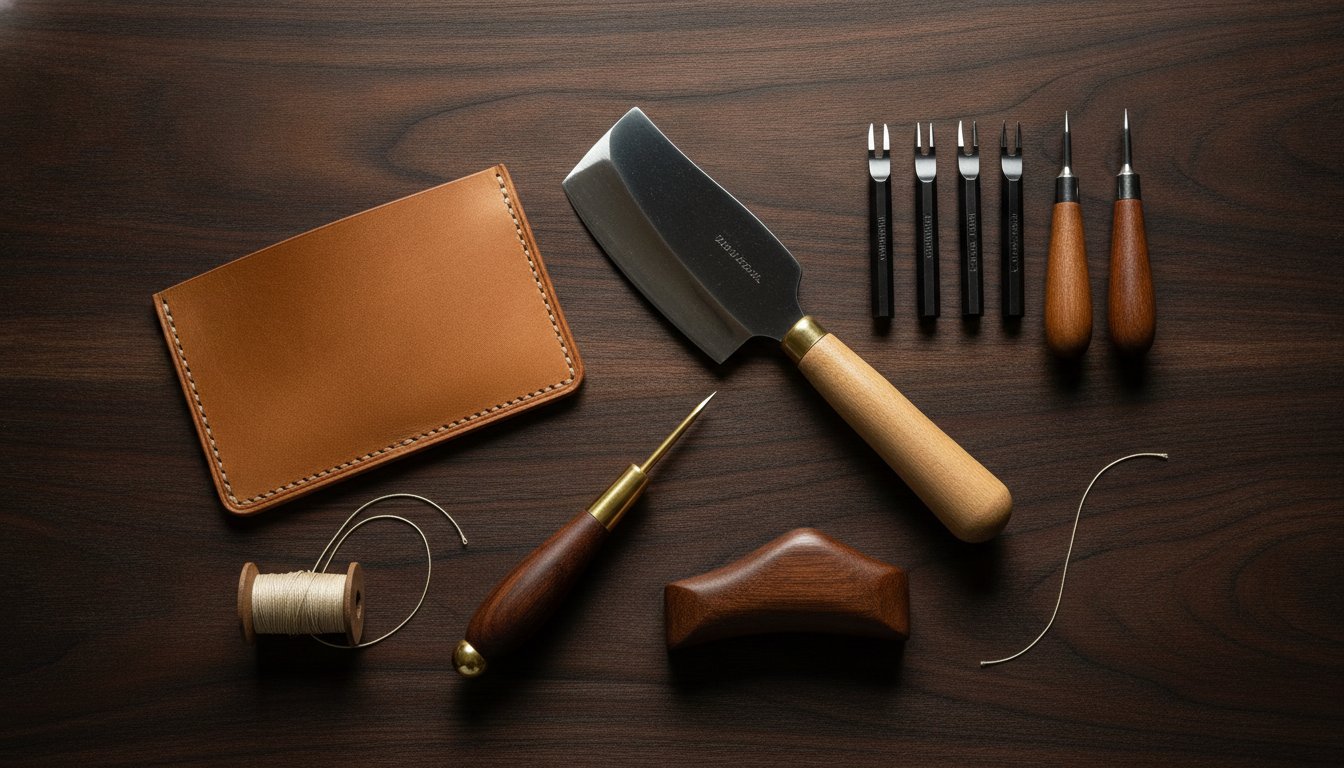
Why invest in premium cowhide only to fight against a dull blade that ruins your edges? It’s a common trap for makers; you buy an inexpensive all-in-one kit only to find the steel loses its edge before you’ve finished your first belt. Since 62% of consumers identify durability as the most important factor when buying leather, your tools must be capable of producing work that lasts. If you’ve struggled with inconsistent stitching or edges that just won’t burnish, the problem isn’t your skill. It’s often the quality of your Leather Working Tools.
We understand that a clean finish requires more than just a steady hand. It demands a curated selection of equipment that matches the weight and temper of your material. Whether you’re working with a delicate 3/4 oz. pigskin or a heavy 8/9 oz. veg-tan shoulder, the right tool makes the difference between a DIY project and a professional-grade heirloom.
In this guide, we’ll help you master the craft by identifying the must-have tools that offer durability and precision. You’ll learn the critical differences between hobbyist and professional grades so you can achieve that sought-after “soft-as-butter” finish. Let’s explore the essential kit required to elevate your workshop to a professional standard.
Key Takeaways
- Learn why professional-grade tools from legacy brands like C.S. Osborne and Craftool are a lifetime investment that grows with your skill level.
- Identify the essential Leather Working Tools for cutting, marking, and stitching that separate hobbyist attempts from heritage-quality craftsmanship.
- Discover how to match specific blades and punches to your material weight to ensure clean, precise results on everything from 3/4 oz. pigskin to 8/9 oz. veg-tan shoulders.
- Understand the critical role of professional finishing, including the proper application of Fiebing’s dyes and the non-negotiable use of dedicated hardware setting tools.
The Foundation of Craft: Essential Leather Working Tools for Every Artisan
Entering the workshop of a professional artisan reveals a deliberate selection of equipment. At Sav-Mor Leather Supply, we believe in the “Master Curator” mindset. This means viewing your Leather Working Tools as a lifetime investment rather than a recurring expense. While entry-level kits offer a low barrier to entry, they often fail to provide the precision required for high-end results. Transitioning to individual professional components allows you to control the quality of every cut and stitch. Since 1970, we’ve seen that legacy brands like C.S. Osborne and Craftool remain the industry standard because they’re engineered for durability. These tools don’t just perform; they grow with you as you refine your skills.
Marking and Measuring for Precision
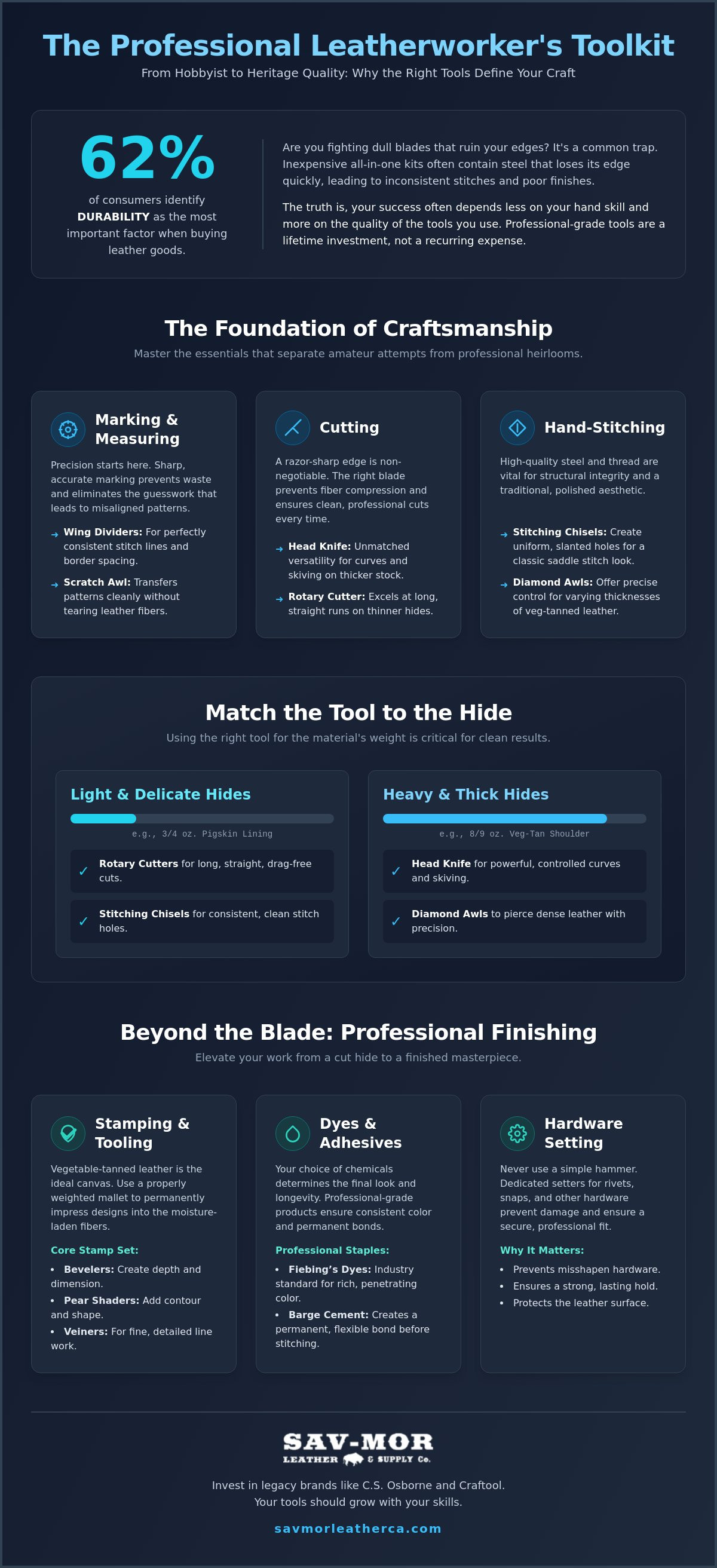
Sharp marking is the prerequisite for a clean finish. Using wing dividers allows you to set consistent stitch lines and border spacing with mathematical accuracy. Similarly, a professional scratch awl is essential for transferring patterns without dragging or tearing the fibers of your cowhide. These leather crafting techniques require tools that hold a point and provide clear, visible guides. Professional Leather Working Tools used for marking prevent leather waste by eliminating the guesswork that leads to misaligned patterns and ruined hides.
The Hand-Stitching Essentials
Choosing between stitching chisels and diamond awls depends on the specific aesthetic you want to achieve. Chisels provide uniform, slanted holes for a traditional look, while diamond awls offer more control for varying thicknesses of veg-tanned leather. High-quality thread is just as vital as the steel that pierces the hide. Browse our professional lacing and thread selection to find the right match for your project’s structural integrity needs.
Technique-Specific Tools: Cutting, Stamping, and Carving
Successful leatherwork depends on matching your tool’s edge to the hide’s weight. A heavy 8/9 oz. veg-tan shoulder requires a different approach than a 3/4 oz. pigskin lining. Using the right Leather Working Tools ensures that you don’t compress the fibers or tear the surface. The swivel knife is the heartbeat of this process, acting as the primary instrument for traditional carving. To maintain the integrity of these crafts, organizations like Heritage Crafts emphasize the importance of using time-tested methods and high-quality implements. Since 1970, we’ve seen how the right weight and balance in a tool can transform a maker’s experience.
Mastering the Cut
Precision starts with your blade choice. Rotary cutters excel at long, straight runs on thinner hides, while the traditional head knife offers unmatched versatility for curves and skiving on thicker stock. Maintaining a razor edge is non-negotiable for achieving “soft-as-butter” garment edges through skiving. This technique thins the leather at the seams, preventing bulky, amateurish finishes. Explore our curated collection of professional leather tools to find blades designed for these specific tasks.
Stamping and Tooling Veg-Tan Leather
Undyed vegetable tanned shoulders provide the ideal canvas for tooling. When you strike a stamp with a properly weighted poly mallet or raw-hide maul, the moisture-laden fibers of the veg-tan accept the impression permanently. Beginners should focus on a core set of stamps: bevelers for depth, pear shaders for contour, and veiners for detail. Choosing a mallet that is too light leads to faint impressions; one that is too heavy can damage your steel stamps over time. Shop premium vegetable tanned leather for your next project to ensure your tooling remains crisp and professional. To secure your finished pieces with style, consider how your choice of professional hardware complements your carving work.
Beyond the Blade: Hardware, Dyes, and Professional Finishing
The transition from a cut hide to a completed piece requires a specialized set of chemical and mechanical aids. While blades define the shape, your choice of adhesives and dyes determines the longevity and aesthetic appeal of your work. Professional assembly often starts with Barge cement for a permanent bond before the first stitch is even placed. Using high-quality Leather Working Tools designed for finishing ensures that your dyes penetrate evenly without streaking. For a comprehensive overview of the basics, this guide on Essential Leather Tools offers a practical starting point for organizing your workshop supplies.
Professional Finishing with Angelus and Fiebing’s
Achieving a designer look requires understanding how different finishes interact with the leather’s surface. When applying Fiebing’s dyes to vegetable tanned leather, use a wool dauber in circular motions for a consistent, deep saturation. Aniline finishes preserve the natural grain and “soft-as-butter” feel of the hide; pigmented paints from Angelus provide a solid, opaque color ideal for vibrant fashion pieces. To keep your work secure during this process, find professional hardware and setting tools that match your project’s specifications.
Essential Hardware for Assembly
Hardware is more than decoration; it’s a structural component. Selecting the correct rivets, snaps, and buckles is vital when working with heavy-duty cowhide. Without the proper setting tools, even the highest quality hardware can fail or look amateurish. Professional Leather Working Tools like anvil sets and specialized punches ensure that every rivet is seated flush and every snap functions smoothly. Shop our full range of artisan accessories and hardware to find the components that will ensure your craftsmanship stands the test of time.
Organize your workshop to facilitate a frictionless workflow. A well-run professional workshop relies on accessible storage for dyes, finishes, and hardware. This efficiency respects your time and ensures that every piece leaving your bench meets a heritage-quality standard. By investing in professional individual components, you build a toolkit that lasts as long as the leather itself.
Elevate Your Craft with Professional-Grade Precision
Elevating your leatherwork from a hobby to a professional standard requires a commitment to quality at every stage. We’ve explored how the right foundation of marking and stitching tools prevents waste and ensures structural integrity. You now understand that matching your blade to the specific weight of your hide, whether it’s a light sheepskin or a heavy 8/9 oz. veg-tan shoulder, is what creates that “soft-as-butter” finish. These technical choices define the difference between a simple project and a heritage-quality heirloom.
Since 1970, Sav-Mor Leather Supply has served as a trusted partner for artisans who refuse to compromise on their equipment. We provide access to legacy brands like C.S. Osborne and Craftool at wholesale prices, ensuring that professional-grade Leather Working Tools are accessible to the entire maker community. Our family-owned expertise is here to guide you in selecting the specific dyes, hardware, and finishes that define professional craftsmanship. We take pride in being the one-stop-shop mentor for your creative journey.
Ready to complete your workshop? Shop Professional Leather Working Tools at Wholesale Prices and start building your legacy one project at a time. Your next masterpiece begins with the right edge.
Common Questions About Professional Leather Working Tools
What are the first 5 leather working tools every beginner should buy?
Every beginner should start with a core selection including a utility knife, wing dividers, a set of stitching chisels, a poly mallet, and a scratch awl. These five Leather Working Tools allow you to perform the fundamental tasks of cutting, marking, and joining with precision. By choosing individual components from legacy brands like C.S. Osborne, you ensure your first tools won’t need immediate replacement as your skills grow.
Is it better to buy a leather tool kit or individual professional tools?
Investing in individual professional tools is superior to buying pre-packaged hobbyist kits. Kits often contain lower-grade steel that dulls quickly, leading to frustration and inconsistent results. Selecting your tools one by one allows you to curate a toolkit tailored to your specific projects. This approach ensures each piece meets the durability standards required for heritage-quality work and professional-grade assembly.
What is the difference between a stitching chisel and a pricking iron?
A stitching chisel is designed to punch entirely through the leather, while a pricking iron is intended only to mark the spacing for a diamond awl. Chisels are more efficient for modern makers working with 3/4 oz. to 8/9 oz. hides. Pricking irons are used in traditional saddlery where the artisan prefers to hand-stitch using an awl for every hole to achieve a specific, high-end aesthetic.
How do I sharpen my leather cutting tools to maintain a professional edge?
Maintain a professional edge by regularly stropping your blades with a leather strop and jeweler’s rouge. You don’t need to regrind the steel often if you strop every few minutes during a long cutting session. Keeping your Leather Working Tools sharp prevents the blade from dragging. This is essential for achieving the clean, “soft-as-butter” edges seen in high-end garment work and premium upholstery.
Can I use regular wood stamps on vegetable tanned leather?
Regular wood stamps are generally unsuitable for vegetable tanned leather because they lack the hardness and detail of professional steel stamps. Wood can crush under the force of a mallet strike or fail to leave a crisp impression in the dense fibers of a veg-tan shoulder. Use hardened steel or brass stamps to ensure your decorative work remains sharp and permanent over the life of the piece.
What tools do I need for setting rivets and snaps in leather?
Setting rivets and snaps requires a dedicated hole punch, a setter matched to the hardware size, and a solid anvil. Without these specific Leather Working Tools, hardware often sets unevenly or fails under stress. Using a professional setter ensures the post is flared correctly. This provides the structural integrity needed for heavy-duty cowhide bags, belts, and other professional-grade leather goods.

Article by
Sav-Mor Leather Supply