

What if the hours spent at your bench are actually costing you money instead of earning it? It’s a common trap for artisans who focus on the craft but struggle with the math. When you don’t know how to price handmade leather goods with precision, you end up undercharging for your skill and feeling burnt out by the very work you love. You likely already realize that guessing your retail price based on what others charge is a recipe for razor-thin margins.
We’re going to change that by mastering a reliable, professional pricing formula that accounts for every hide, tool, and hour spent in your workshop. You’ll learn to calculate your true Cost of Goods Sold by factoring in shipping, waste, and overhead expenses. We’ll also explore how sourcing premium materials like veg-tanned leathers and heritage hardware allows you to command higher prices with confidence. By the end of this guide, you’ll have a repeatable system to ensure your business is as durable as the goods you create.
Key Takeaways
- Account for the “yield gap” by factoring in natural hide defects and unusable edges into your initial material costs.
- Master how to price handmade leather goods using a professional formula that combines materials, labor, and overhead for consistent profit.
- Set a sustainable hourly rate that differentiates between high-skill bench work and necessary administrative or packaging tasks.
- Learn why a 20-30% profit margin is the essential baseline for scaling your craft from a hobby into a professional artisan business.
Calculating Your Base: True Material Costs and Leather Yield
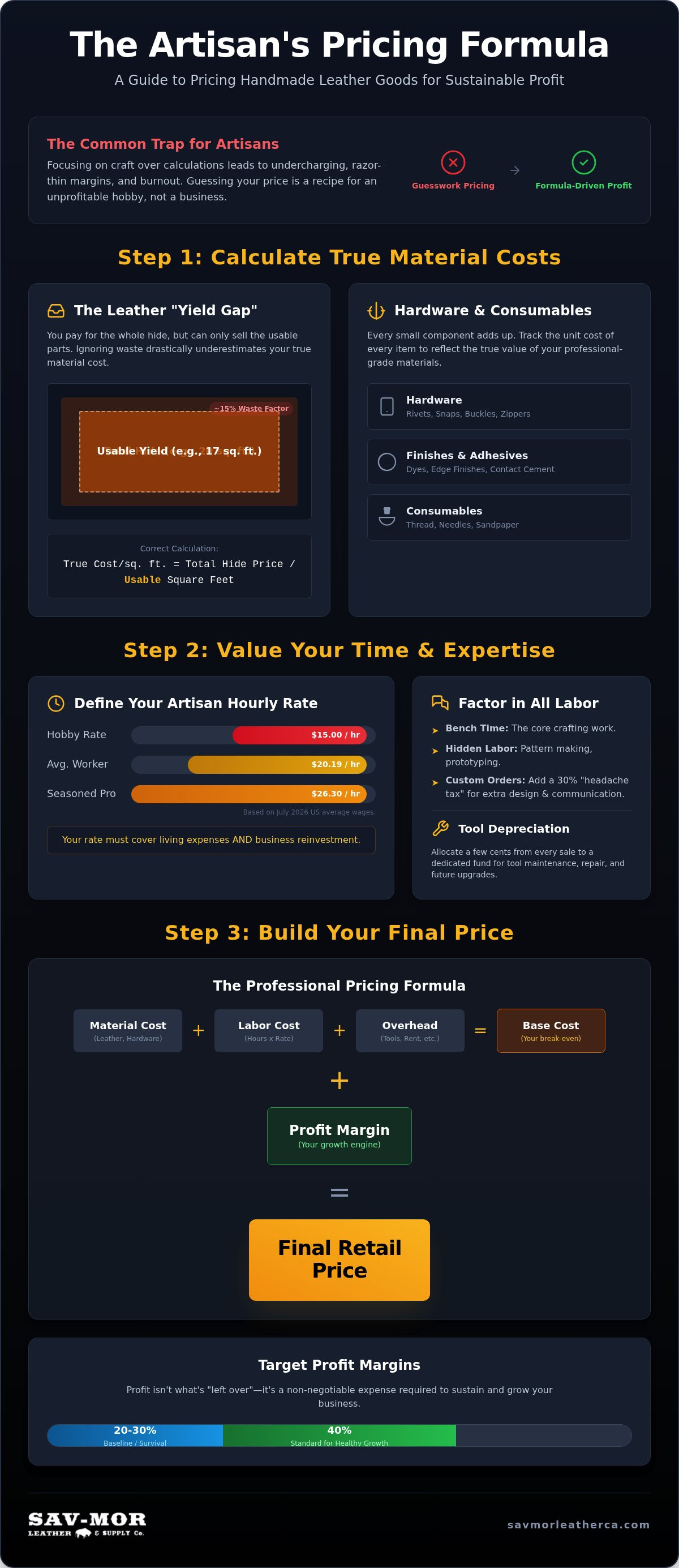
Calculating your base cost starts with the material on your bench. Many makers make the mistake of simply dividing the price of a hide by its total square footage. This ignores the reality of the yield gap. To understand how to price handmade leather goods effectively, you must realize that you are paying for the whole hide, but you can only sell the usable parts. Implementing a cost-plus pricing strategy requires you to account for this discrepancy from the very beginning. If you buy a 20 square foot side but only 17 square feet are clear of brands and holes, your cost per foot is higher than the invoice suggests.
Understanding Square Footage vs. Useable Yield
Natural hides are organic products. They contain scars, insect bites, and thin belly edges that aren’t suitable for professional goods. Industry standards from 2026 suggest a 15% waste factor for most projects, but this can climb higher depending on your pattern layout. Premium vegetable tanned leather often provides a more consistent surface for tooling, which improves your overall yield compared to lower-grade hides. When working with specific weights, like a 3/4 oz. for slim wallets or an 8/9 oz. for heavy duty belts, calculate your cost based on the actual square inches the pattern consumes plus that 15% buffer. This ensures you aren’t gifting the customer the leather you had to throw away.
Accounting for Hardware and Finishing Supplies
The leather is only part of the story. Professional results require high-quality leather craft hardware that won’t fail the end user. Every rivet, snap, and buckle has a unit cost that must be added to your base. Don’t overlook consumables like thread, dyes, and edge finishes. While a single yard of thread seems negligible, the cumulative cost of these supplies across a production run will impact your margins if left uncounted. Track every component to ensure your final price reflects the true value of the materials used in your workshop.
Labor, Consumables, and the Cost of Professional Craftsmanship
Labor represents the heart of your workshop, but it’s also the most frequently miscalculated expense. While materials are tangible, your time is often treated as a flexible resource. To truly understand how to price handmade leather goods, you must account for every minute spent on a project. This includes the “hidden” labor of pattern making, prototyping, and the 30% “headache tax” often applied to custom bespoke orders to cover the extra communication and design work required. Efficiency is your best ally here. Current industry data shows that batching production, such as making 10 cardholders at once rather than one at a time, can reduce per-unit labor time by as much as 25%.
Defining Your Hourly Artisan Rate
As of July 2026, the average hourly wage for a leatherworker in the US is approximately $20.19, while a seasoned Leather Craftsman can earn an average of $26.30 per hour. If you’re charging $15 per hour, you’re not running a business; you’re funding a hobby. Utilizing proven small business pricing strategies helps you set a rate that covers both your living expenses and necessary business reinvestment. Don’t forget the “consumable tax” either. Every drop of Fiebing dye, contact cement, or specialty finish used on a project has a cost that must be built into your unit price rather than ignored as a general expense.
Depreciating Professional Tools and Equipment
Professional-grade equipment is an investment that pays off over decades of use. High-quality professional leather tools from legacy brands like C.S. Osborne are built to last, but they still require maintenance and eventual replacement. Tool depreciation is a necessary business overhead expense where you allocate a few cents from every sale into a dedicated fund for future upgrades. This ensures that when a favorite maul or edger finally reaches the end of its life, the replacement is already paid for by your previous sales. Selecting the right professional hardware for your finished pieces ensures that the quality of your work matches the high standards of the tools used to create it.
The Profit Formula: Scaling from Hobbyist to Professional Artisan
Once you’ve calculated your material yield and labor, it’s time to assemble the final equation. A sustainable profit formula is the only way to move beyond a hobby and build a legacy business. The most effective way to understand how to price handmade leather goods for the long term is to treat profit as a non-negotiable expense rather than a “leftover” amount. While some beginners aim for a 20-30% margin, a 40% profit margin is the standard for healthy growth. To achieve this, industry professionals often divide their total costs by 0.60 to reach a retail price that covers future expansion and market fluctuations.
Consulting Basic Pricing Strategies for Small Businesses provides a reliable framework for these calculations. It ensures you account for variables like Etsy’s 6.5% transaction fee or payment processing costs before your product reaches the customer. Pricing isn’t just about covering today’s hide; it’s about funding tomorrow’s workshop.
The Standard Retail vs. Wholesale Pricing Formula
To scale your brand, you must prepare for future gallery or boutique partnerships. The standard model involves calculating your wholesale price by doubling your total cost of materials and labor. Your retail price then doubles that wholesale figure, effectively creating a “keystone” markup of four times your base cost. This structure ensures that even when a retail partner takes a 50% commission, you still earn your full profit. If your Cost of Goods Sold is too high to allow for this doubling, your sourcing strategy needs immediate adjustment.
Leveraging Wholesale Sourcing to Protect Your Margins
Your profit margin is directly tied to your ability to lower your entry costs without sacrificing quality. Sourcing wholesale leather and professional tools from a trusted partner like Sav-Mor allows you to access premium hides at a lower price point. By utilizing heritage brands like Fiebing and Angelus for your finishes, you justify a premium retail price through the reputation of your components. This strategic sourcing protects your margins and keeps your workshop competitive in a crowded marketplace.
Build a Sustainable Leathercraft Business
Mastering the math behind your workshop is just as essential as mastering the saddle stitch. By accounting for the yield gap in every hide and setting an artisan labor rate that respects your expertise, you move from guessing to growing. You now have a professional framework for how to price handmade leather goods that protects your time and your margins. Remember that a healthy business doesn’t just cover today’s bills; it funds the tools and materials you’ll need for years to come.
Success in this craft depends on the quality of your materials as much as your pricing strategy. Since 1970, our family-owned business has provided the maker community with the same high-end supplies we use ourselves. We offer wholesale prices for everyone and provide national shipping across the USA to ensure you have what you need at your bench. Whether you’re sourcing veg-tanned hides or professional hardware, your choice of supplier directly impacts your bottom line.
Ready to lower your production costs and elevate your final results? Shop premium leather and professional tools at wholesale prices and start building a business that lasts for generations. Your craft is worth every cent; make sure your price tag reflects it.
Frequently Asked Questions
How do I account for leather waste in my pricing?
Account for a standard 15% waste factor by calculating your cost based on usable square footage rather than the total size of the hide. Natural imperfections like brands, scars, or thin belly edges are part of the material cost the customer pays for. To get an accurate figure, add the shipping cost of the hide to the purchase price and divide by the estimated usable area to find your true cost per square foot.
What is a fair hourly rate for a leather crafter in 2026?
Set your rate based on your specific skill level and local market demands. As of July 2026, the average hourly wage for a leatherworker in the United States is approximately $20.19. More experienced artisans categorized as a “Leather Craftsman” earn an average of $26.30 per hour. When learning how to price handmade leather goods, choosing a rate in this range ensures your business remains sustainable and reflects professional standards.
Should I include the cost of shipping in my product price?
Include shipping costs within your retail price if you plan to offer “free shipping” as a marketing incentive. Remember that platforms like Etsy apply their 6.5% transaction fee to the total sale amount, including shipping. If you don’t bake these costs into the price, you’ll see a direct reduction in your profit margins. Always calculate the weight and packaging materials for each product to ensure your shipping estimates are accurate.
How do I price custom leather commissions vs. standard stock?
Apply a 30% premium to your base rate for bespoke or custom orders to account for the extra communication and pattern making involved. Standard stock items are more profitable because you can utilize batching, which can improve efficiency by up to 25%. This “headache tax” for custom work ensures that the unique design time doesn’t eat into the profit you’ve carefully calculated for your how to price handmade leather goods formula.

Article by
Sav-Mor Leather Supply