
Why does achieving a perfectly straight line feel like the most difficult skill to master in the workshop? You’ve likely felt the frustration of a ruler slipping mid-stroke or a blade dragging through soft-as-butter garment leather, leaving a jagged edge that ruins your project. Learning how to cut leather straight is about more than just a steady hand; it is about understanding how different weights react under tension. It’s a common struggle that leads to wasted material, but professional results are well within your reach.
This guide teaches you the professional techniques and tool selections required to achieve clean edges on every project. You will discover how to handle various weights, from delicate 3/4 oz. skins to robust 8/9 oz. veg-tan shoulders. We will preview the essential C.S. Osborne blades and the workshop secrets our family has trusted since 1970 to ensure every cut is clean, confident, and ready for a perfect burnish.
Key Takeaways
- Discover why professional tools like C.S. Osborne blades and cork-backed metal rulers are essential for stabilizing hides and preventing dangerous blade wander.
- Learn the “Perpendicular Rule” and other advanced techniques for how to cut leather straight, ensuring clean edges on everything from 3/4 oz. skins to 8/9 oz. veg-tan.
- Master the art of squaring up a new hide to establish a true straight edge before you begin your patterns, significantly reducing material waste.
- Identify and fix common errors like the “bird-beak” effect at the start of your cuts to achieve the crisp edges required for high-end burnishing.
Essential Tools and Preparation for Straight Leather Cuts
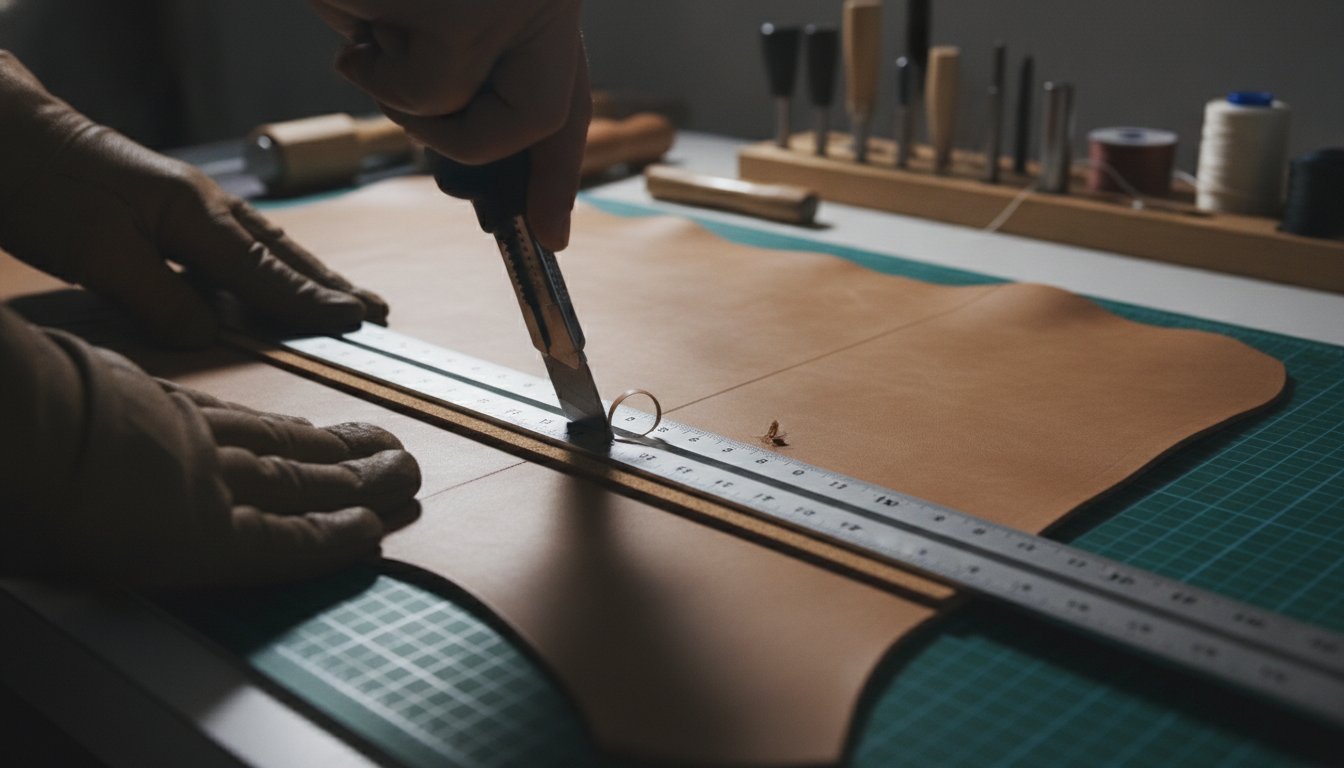
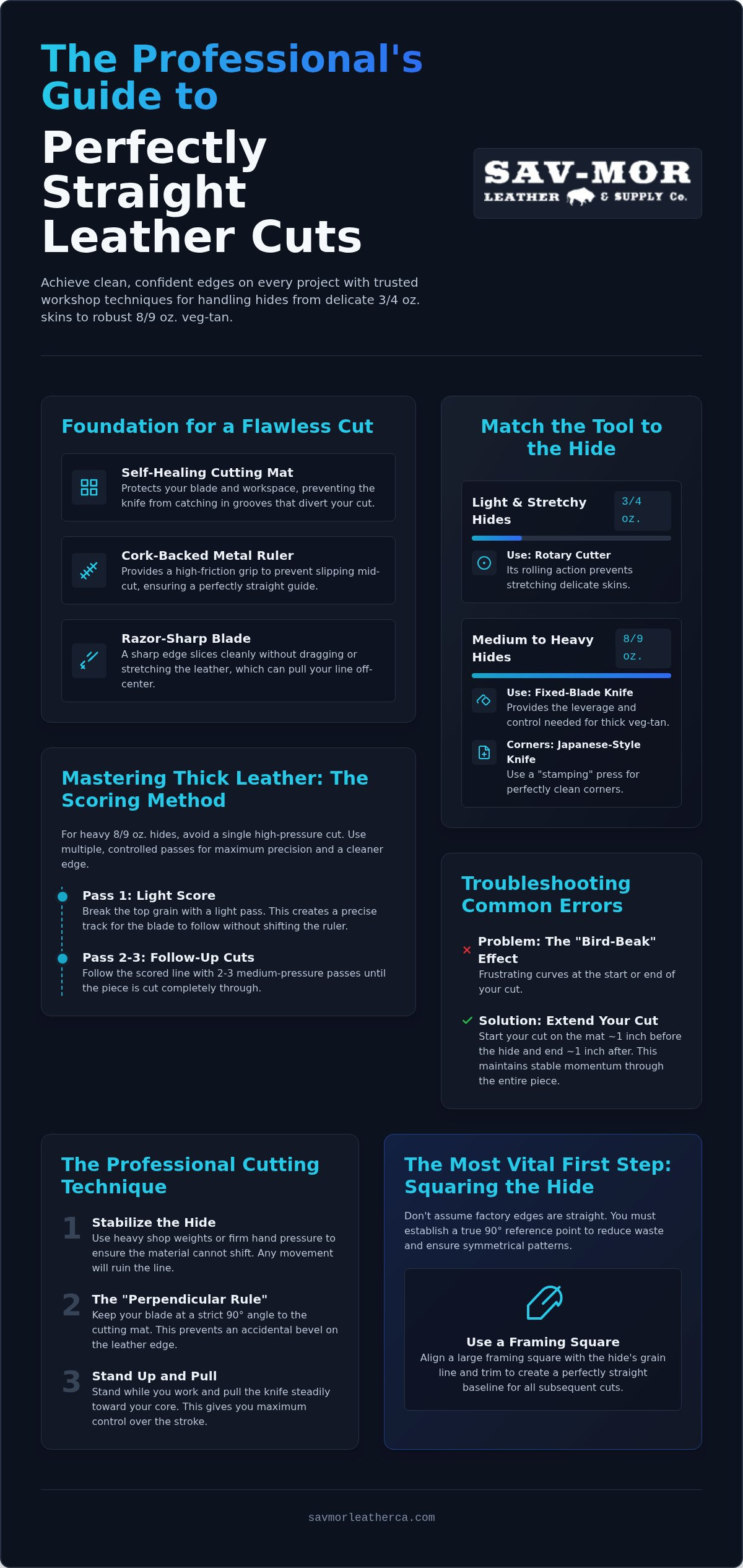
Your success in learning how to cut leather straight begins with your foundation. A dedicated workspace equipped with a self-healing cutting mat is vital. These mats allow the blade to pass through the grain without catching in deep, permanent grooves that might divert your hand. To stabilize the hide, a metal, cork-backed ruler is non-negotiable. The cork provides a high-friction grip that prevents the ruler from sliding mid-cut, while the steel edge protects your fingers and ensures the blade stays on its intended path.
Blade sharpness is a critical factor in how to cut leather straight. A dull edge doesn’t slice; it pushes the material, creating a “drag” that stretches the leather and pulls your line off-center. Explore our curated collection of professional leather tools to ensure your workshop is equipped with the same industry-standard gear used by artisans since 1970. Wholesale pricing makes these premium tools accessible for every level of maker.
Matching Tool Selection to Leather Weight
Different hides require specific cutting methods. For “soft-as-butter” garment leather or thin 3/4 oz. skins, a rotary cutter is often the superior choice. Its rolling action applies downward pressure that prevents the stretching common with fixed blades. When you work with heavy-duty 8/9 oz. vegetable tanned leather shoulders, you need the leverage of a fixed-blade knife from trusted brands like C.S. Osborne or Craftool.
- Rotary Cutters: Use these for thin, stretchy hides to maintain dimensional stability during the stroke.
- Fixed-Blade Knives: Rely on these for medium to heavy weights where control and pressure are paramount.
- Japanese-Style Knives: Use the “stamping” technique by pressing the blade straight down to finish clean corners on thick 8/9 oz. hides.
The Professional Technique: A Step-by-Step Cutting Guide
Stabilize your hide before the blade ever touches the grain. Use heavy shop weights or apply firm, spreading pressure with your non-cutting hand to ensure the material cannot shift. If the leather moves even a fraction, the straight line is lost. Maintain a strict 90-degree angle between your blade and the cutting mat. This “Perpendicular Rule” is essential for how to cut leather straight because it prevents the edge from developing an accidental bevel. Stand up while you work. Pull the knife steadily toward your core to maintain maximum control over the stroke.
Consistency in the material itself is just as important as your technique. Find premium leather hides that offer uniform density across the entire surface. Hides with inconsistent thickness or loose grain can cause even the sharpest blade to wander off course. Once you have achieved a clean, straight cut, you’ll be ready to select the right leather hardware for a professional assembly.
The Scoring Method: Multiple Passes for Maximum Precision
Avoid the common mistake of trying to slice through thick 8/9 oz. veg-tan in a single motion. Instead, use the scoring method. Start with a light pass that only breaks the top grain. This establishes a precise track for the blade to follow without requiring enough pressure to shift your ruler. Follow this score line with two or three additional medium-pressure passes until the piece is free. This controlled approach prevents the ruler from slipping and results in a much cleaner edge than a high-pressure single cut. It’s a foundational skill for how to cut leather straight on heavier weights.
Troubleshooting and Achieving a Professional Finish
Many makers skip the most vital step in the workshop: squaring the hide. You shouldn’t assume a raw hide arrives with perfectly straight factory edges. To master how to cut leather straight, you must first establish a true 90-degree reference point. Use a large framing square to find the grain line and trim away the irregular factory sides. This process provides a reliable baseline for every subsequent strap or panel you cut from the hide.
Starting with a True Edge: The Squaring Process
Align your framing square with the straightest section of the hide’s spine or grain. Mark a line that’s perfectly perpendicular to this axis. Trimming this first edge ensures your patterns won’t “lean” or twist as you work. Whether you’re using a 3/4 oz. sheepskin or a heavy 8/9 oz. cowhide, a squared baseline is the only way to guarantee professional symmetry across your entire project.
Address the “Bird-Beak” effect by analyzing your entry and exit points. This frustrating curve occurs when the blade isn’t fully stabilized before it hits the leather grain. Start your cut on the mat, roughly an inch before the hide, and follow through until the blade is completely clear of the material. This maintains the momentum needed for how to cut leather straight without the tip wandering at the finish.
Your edge finishing depends entirely on the quality of the initial cut. Crooked edges make burnishing nearly impossible and result in uneven stitching lines. Most importantly, professional hardware like buckles and rings requires straps with parallel sides to fit correctly. A belt or bag strap that tapers accidentally will bind in the hardware, ruining the tactile beauty and function of a premium piece. Precision at the cutting stage is what separates a hobbyist from a professional artisan.
Elevate Your Craft with Precision Cuts
Mastering your workshop skills requires the right balance of professional-grade tools and disciplined technique. By squaring your hides before you begin and utilizing the multi-pass scoring method, you eliminate the guesswork and material waste that often plague makers. Learning how to cut leather straight is the foundational skill that makes every subsequent step, from edge burnishing to hardware installation, significantly more efficient. Trusting your hands starts with trusting your equipment.
Shop Professional Leatherworking Tools and Premium Hides at Sav-Mor Leather Supply to access wholesale pricing on legacy brands like C.S. Osborne and Craftool. We provide national shipping on all our expertly curated hides and supplies, supporting artisans with the same quality we’ve delivered since 1970. Equip your workshop today and approach every hide with the quiet confidence of a master artisan.
Frequently Asked Questions
What is the best knife for cutting straight lines in thick leather?
A heavy-duty utility knife or a rigid Japanese-style skiving knife from legacy brands like C.S. Osborne is the superior choice for thick 8/9 oz. vegetable tanned leather. These professional tools offer the structural integrity needed to resist blade flex. Unlike thin hobby knives that bend under pressure, a fixed blade stays true to the line, allowing for the deep, clean passes required for heavy project components.
Why does my leather stretch and pull when I try to cut it?
Stretching usually results from a dull blade or excessive horizontal drag on thin, 3/4 oz. skins. When the edge isn’t razor-sharp, it pushes the fibers rather than slicing them. To learn how to cut leather straight on soft-as-butter garment hides, always use a fresh blade and consider a rotary cutter. This tool applies vertical pressure, which prevents the material from bunching or pulling during the stroke.
How do I prevent my metal ruler from slipping on the leather?
You can prevent slipping by using a professional metal ruler with a cork-backed base. This backing provides the necessary grip to lock onto the leather grain. If you’re using a standard steel ruler, apply a few pieces of fine-grit sandpaper or grip tape to the underside. Combining this with heavy workshop weights ensures the material and the straightedge remain perfectly stationary until the cut is complete.
Is it better to push or pull the knife when cutting leather?
Pulling the knife toward your body is the most effective technique for how to cut leather straight. This motion engages your larger muscle groups, providing a level of stability that pushing simply cannot match. By standing over your work and pulling the blade in a steady, rhythmic motion, you maintain better visibility of the line and significantly reduce the risk of the blade jumping the ruler.

Article by
Sav-Mor Leather Supply